






DFDesign Futures AIGA reader
AIGA Design Futures · Published 2018

Seven shifts in design practice.

AIGA’s Design Futures research describes seven conditions already changing professional practice and design education. The series is not a forecast of what design might become. It examines changes already visible in the field and the capabilities AIGA argued would become more important as those changes continued.

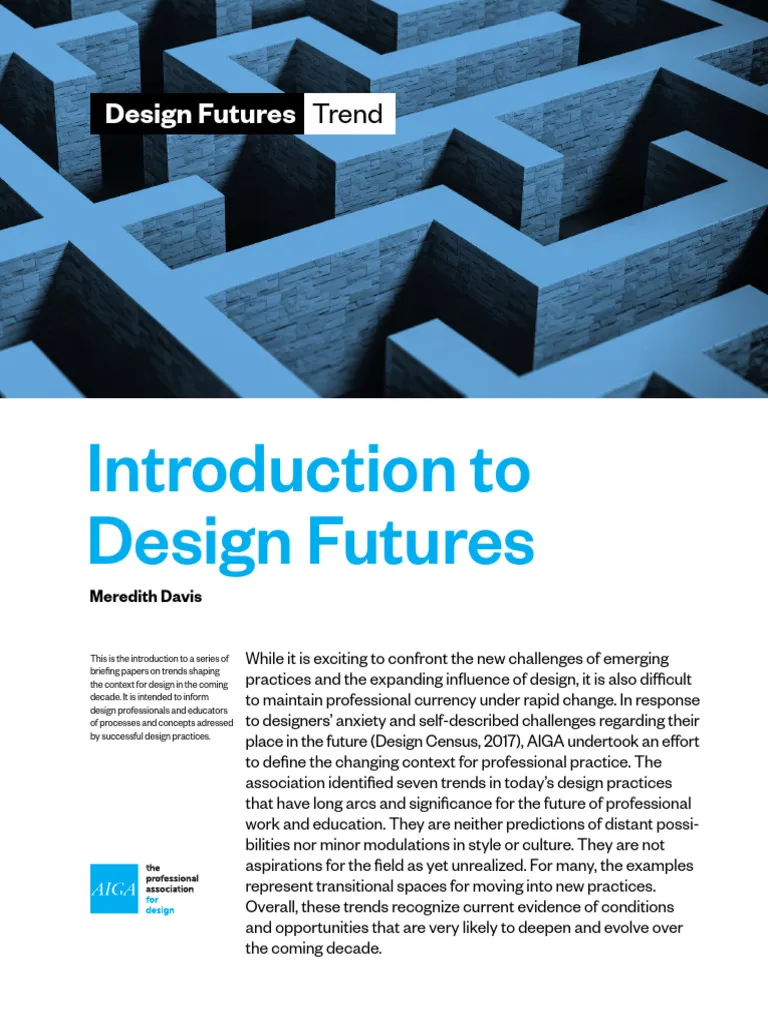
Cover of AIGA's Introduction to Design Futures briefing paper

The context behind the seven trends.

AIGA began the work in response to a practical problem: professional design was changing faster than many established models of design education and career development. The association identified seven trends with long arcs across current practice and used them to describe areas where designers, educators and organizations would need different knowledge, methods and forms of collaboration.

The papers are explicit about what they are not. The trends are not distant predictions, changes in visual style, or aspirations that had yet to appear. AIGA presents them as evidence of conditions already underway and likely to deepen over the following decade.

The title Designer 2025 names the horizon of the original initiative. It is not the publication date of the final briefing series.
2017AIGA introduces Designer 2025 and the seven-trend framework.
2018The expanded Design Futures briefing papers are published.
2025The future horizon the initiative was originally examining.
Read the original introduction ↗

From an industrial model to a changing field

AIGA contrasts contemporary practice with an industrial-age model of design built around improving the appearance and function of discrete messages, products and environments. In that model, designers developed through technical production and form-giving, working toward highly refined finished artifacts.

The knowledge economy and rapid technological change altered the stopping condition. Products and services could be updated continuously; information became fluid rather than fixed; user behaviour could be observed in use; and research became part of ongoing design. The work increasingly concerned systems, services, interaction, strategy and consequences rather than only the form of an object.

AIGA also describes a less linear path into the profession. Different roles require different combinations of design, technology, research and strategy. Technical mastery no longer functions as the single threshold through which all designers pass before taking on broader responsibility.

What the briefing papers are designed to contain

The seven papers use a consistent structure. They do more than name a trend. Each connects a changing condition to evidence from practice and then to the capabilities expected of students and working professionals.

TrendWhat is changing in the context for design.
EvidenceExamples already visible in professional practice.
ConceptsIdeas and principles needed to understand the change.
CompetenciesWhat students should learn and what professionals may need to develop.
ResourcesFurther reading from design and adjacent fields.

This matters for how the seven trends should be read. They are not seven isolated topics. Together they describe a broader change in what counts as design work, where it happens, and what designers are expected to understand.

Trend 01

Complex Problems

Even a discrete assignment sits inside larger physical, psychological, social, cultural, technological and economic systems. Design therefore includes relationships, feedback, competing priorities and consequences—not only the artifact being produced.

What is changing

AIGA argues that the mid-century focus on appearance and function is too narrow for many contemporary problems. Constraints do not arrive one at a time, remain stable, or stop at the formal boundary of a product. They interact. A change intended to improve one part of a system can alter behaviour or create effects somewhere else.

This moves the designer from treating the brief as a closed object toward understanding inputs, relationships, stakeholders, feedback and conditions over time. The problem can be open-ended, dynamic and networked across organizations. The boundaries of the work have to be examined rather than assumed.

Evidence in practice

Adaptive identity systems

AIGA points to identity programs whose form changes with external conditions. Neue Design Studio’s identity for northern Norway, for example, uses weather data so the graphic symbol responds to wind direction and temperature. The identity is not a fixed mark; it is a rule-based system.

Designing an institution rather than a single artifact

IDEO’s work with Innova Schools in Peru is used as a larger-scale example. Curriculum, teaching, buildings, operations and financial structure are treated as related parts of one system rather than as independent design assignments.

Core concepts and tensions

Systems thinking does not mean that every project has to solve an entire system. The practical problem is deciding where to draw a boundary and where intervention is possible. AIGA emphasizes leverage points: places where a relatively focused change can influence wider behaviour or conditions.

That also changes the role of expertise. Designers still bring their own methods, but complex systems exceed any one discipline. Progress depends on working with people who understand other parts of the problem and on making relationships visible enough for groups to reason about them together.

What this asks of designers

  • Map components, relationships, flows and feedback across different scales.
  • Identify leverage points rather than treating every part of the system as equally actionable.
  • Use scenarios, journeys, models and other representations to make system behaviour discussable.
  • Work with stakeholders whose priorities may conflict and facilitate decisions under changing constraints.
  • Consider social, cultural, technological, physical, environmental and economic consequences together.

Education and continuing practice

The paper places more weight on interdisciplinary learning, facilitation, negotiation and theories of change. The designer is not expected to become an expert in every adjacent field. The requirement is different: understand enough about other modes of inquiry to collaborate, ask useful questions, and recognize when the design problem exceeds the methods of design alone.

Trend 02

Aggregation & Curation

Third parties increasingly assemble and re-present messages, products and services from different sources. Aggregation can connect useful things, but it can also remove context, narrow exposure and reduce the original source’s control over meaning.

What is changing

AIGA describes an environment in which people rarely encounter information only where its original producer intended. Search engines, feeds, marketplaces, recommendation systems, playlists and user-created collections gather material from multiple sources and present it through a new frame.

That can improve an experience. An aggregate can bridge gaps between related information or activities and let people assemble a set of tools around their own goals. The same mechanism can create a filter bubble, however, when algorithms infer preferences from location, history or past behaviour and repeatedly narrow what appears.

The design problem is partly about context

When a message is separated from its original environment, visual identity, attribution, sequence and surrounding explanation may disappear. AIGA connects this to diminished brand awareness and communication fragmentation: the original source no longer controls where its material appears or what sits beside it.

Curation adds another layer. People trim, rank and organize aggregates according to their own needs. The useful unit is no longer necessarily one publisher, company or service. It can be a personal ecology assembled across many providers.

Core tensions

  • Convenience versus breadth. Personalization can reduce effort while also reducing exposure to unfamiliar material.
  • Persistence versus context. A message may travel widely while losing the framing that gave it meaning.
  • Source identity versus user control. Designers may want coherent brand expression while users expect to remix services around their own purposes.
  • Aggregation versus integrity. The value of combining sources depends partly on preserving enough provenance for people to judge what they are seeing.

What this asks of designers

AIGA asks students to design symbols and language that can maintain meaning when removed from their original environments; describe clusters and ecologies of information, products and services; examine how filtering affects what people know; and understand curation as a basis for conversational or community interaction.

For professionals, the paper points toward data-aware preference systems, branding strategies that can survive fragmentation, and service ecologies that combine offerings from multiple providers without assuming one organization controls the whole experience.

Trend 03

Bridging Digital & Physical Experiences

People move across devices, environments and activities as part of one continuous goal. The experience includes what happens before and after the screen, and breakdowns often occur at the handoffs between channels, places and service providers.

What is changing

Digital interactions are increasingly embedded inside larger physical and social activities: buying online and collecting in a store, checking in before arriving somewhere, summoning transportation, navigating a building, or using a phone to add information to a physical setting. AIGA’s point is not simply that more things are digital. It is that users experience these steps as one activity even when different systems produce them.

The gaps are therefore part of the design problem. People can lose support when moving from online to offline, repeat information because systems do not connect, or reach a physical environment without the feedback they had digitally.

Evidence in practice

Click-and-collect and in-store support

The paper uses retail to show how one task spans online purchase, physical travel, arrival, navigation and pickup. Lowe’s is cited for tools that support customers and employees in finding products, including experiments with augmented-reality navigation.

Augmented and mixed reality

AIGA points to tourism, wayfinding, sport, architecture and education as cases where digital information is layered onto physical situations. Microsoft HoloLens is used as an example of virtual objects being anchored to real environments so people can act on both at once.

Core concepts

The paper uses the experience cycle to frame how people connect with, orient to, interact with, extend and eventually advocate for an experience. Touchpoints are the moments through which that cycle is delivered. Journey maps make those moments visible from a user’s point of view.

AIGA warns against journey maps that show an unrealistically smooth path. The useful parts often include confusion, errors, repeated effort and unsupported transitions. Those points can reveal leverage for redesigning the wider service ecology rather than polishing one interface.

What this asks of designers

  • Map the complete ecology of information, products, services and environments involved in a goal.
  • Identify gaps where people lose support, repeat work or lack information and feedback.
  • State the role technology should play rather than treating technology as the experience itself.
  • Understand network effects and platform choices that make connected services possible.
  • Prototype changes across touchpoints and examine the consequences for the rest of the journey.

Education and continuing practice

AIGA extends professional learning into platform design, partnerships among providers, customization, and the orchestration of continuous experiences. Designing across digital and physical settings often requires agreements and infrastructure beyond the design team’s direct control.

Trend 04

Core Values Matter

People judge organizations through the relationship between what they say and how their products, services, policies and behaviour operate. Values therefore enter design as practical constraints and consequences, not only as statements of intent.

What is changing

AIGA connects this trend to increased public visibility into organizational behaviour. People can compare messages with experiences, environmental effects, labour practices and social conduct. Trust depends less on a controlled communications layer when customers and communities can publish their own evidence.

The paper describes quality, reliability and transparency as important factors in how people judge brands, while broader concern for social and environmental impact creates pressure for consistency between an organization’s stated ethos and its operations.

Values are not a separate category of design

One of the stronger arguments in the paper is against isolating socially responsible work under a special label while treating ordinary commercial design as ethically neutral. Any design decision can distribute access, create waste, reinforce exclusion, change behaviour or privilege one stakeholder over another.

This does not make the ethical answer obvious. AIGA explicitly cautions against reducing the discussion to “commercial work is bad” and “social work is good.” Designers face conflicts among stakeholders, legal requirements, business viability, public consequences and values that may not align.

Equity and participation

The paper draws on equity-centered design approaches that ask designers to examine their own assumptions, make hidden power relationships visible, share authority with people affected by the work, and design with rather than simply for communities. Equality of process does not guarantee equitable outcomes when people begin from different positions.

What this asks of designers

  • Clarify the values of organizations and stakeholders before translating them into messages or experiences.
  • Identify conflicts between stakeholder priorities and broader social or environmental effects.
  • Consider the lifecycle of products and services, including what happens when people discard, abandon or stop using them.
  • Evaluate access, inclusion, resource use and long-term consequences alongside conventional measures of performance.
  • Develop viable ways to sustain socially focused design practice rather than treating good intent as an economic model.

The measurement problem

AIGA argues that familiar success measures—short-term client profit or appearance awards—are insufficient for some of the outcomes being discussed. If design claims social or environmental value, it needs ways to examine those effects over longer periods. That tension leads directly into the later paper on accountability and research.

Trend 05

Resilient Organizations

Rapid technological and social change affects the structures through which organizations create value, not only the appearance of what they offer. AIGA places design inside questions of innovation, business models, leadership and organizational adaptation.

What is changing

The paper starts from a broad use of “business.” Design can support the operation of a design office, contribute to a client’s strategy, or participate in bringing products and services to market. These are different capabilities, and AIGA notes that design education has not always agreed on how much business preparation belongs in an undergraduate curriculum.

The central issue is resilience: the capacity of an organization to respond to opportunities and threats when technology, customer expectations, competitors and internal conditions are changing. Innovation can come from many parts of the organization and can have a shorter useful life than before.

Innovation is broader than product form

AIGA uses Larry Keeley’s ten types of innovation to divide change across three areas: internal systems such as profit model, network, structure and process; offerings such as product performance and product systems; and customer-facing experience such as service, channel, brand and engagement.

iTunes and the system around the product

The paper uses Apple to show that innovation may lie in the business and service model surrounding a physical product. The value of the device depends on a wider network for obtaining, managing and using content.

Streaming and short-lived advantage

Changes from owned media to streaming illustrate how quickly a once-successful model can be displaced. Resilience therefore requires the organization to keep observing and adapting rather than treating innovation as a one-time event.

What this asks of design

Design can contribute to both outward-facing offers and inward-facing organizational conditions. That requires understanding how decisions are made, how resources move, what incentives exist, and whether teams can act on the insights design produces.

  • Connect user or community insight to organizational strategy rather than isolating it in project deliverables.
  • Understand different forms of innovation and where design can influence them.
  • Work across business, technology and design without assuming those groups use the same definitions of value.
  • Create conditions for ideas to move through an organization, including collaboration and leadership practices.
  • Recognize that social innovation has the same problem of sustainability: practices must remain economically viable if they are expected to create durable change.

A tension in the paper

AIGA does not argue that every designer should become a business strategist. It does argue that design work increasingly enters environments where business models, organizational structures and leadership decisions shape whether an intervention can exist. The professional question is therefore how much of that context a designer must understand to work effectively.

Trend 06

Making Sense in the Data Economy

Networked technologies do not simply display information. They collect data, infer patterns, adapt and participate in communication. AIGA treats data and intelligent systems as materials of design as well as forces that change how people understand the world.

What is changing

The paper by Meredith Davis, Hugh Dubberly and Paul Pangaro begins with a tension: technologies serve people while also constraining the forms through which people communicate and think. Connected devices, cloud infrastructure and machine intelligence mediate what can be observed, represented and acted upon.

Data becomes abundant rather than scarce. Sensors and digital systems allow continuous measurement where earlier models relied on samples. Knowledge can move from hierarchical structures toward networks, and models can update in real time rather than remaining fixed until the next publication or study.

From objects to systems and platforms

For design, the significant change is not merely a larger quantity of information to visualize. Designers increasingly work on the rules, interfaces and feedback through which information systems operate. The object of design can become a platform or a set of conditions from which many outcomes emerge.

This is close to what the paper calls meta-design: creating environments or frameworks that others participate in and continue to shape. The designer cannot specify every future state in advance because users, data and connected services keep changing the system.

Artificial intelligence and feedback

AIGA was writing before the current generative-AI wave, but the paper already treats machine intelligence as part of everyday interaction. People produce data through use; systems learn from that data; the resulting responses alter what people see and do; and those actions create more data. The relationship is recursive.

That creates a sensemaking problem as well as a technical one. Networks can weaken traditional authorities and make it easier for information to circulate without stable context. Designers therefore need to think about how people judge patterns, evidence, provenance and uncertainty—not only how clearly a chart is drawn.

What this asks of designers

  • Understand data as a designed material: how it is collected, structured, represented and used.
  • Recognize feedback loops between people and adaptive systems.
  • Design for conversation and participation rather than only one-directional communication.
  • Work at the level of platforms and ecologies where outcomes are partly produced by users and other systems.
  • Collaborate with technologists and data specialists while retaining responsibility for human interpretation and consequences.

Education and continuing practice

The paper is explicit that software proficiency alone is not technological literacy. Programs need either faculty who can work at the level of technological systems or meaningful partnerships with technologists. The design question is how a system behaves and what possibilities it creates, not simply which software produced the interface.

Trend 07

Accountability for Anticipating Design Outcomes

Research does not end when a design direction has been chosen. If interventions influence complex social and technological systems, designers need evidence before, during and after production, and a clearer account of what they expect their work to cause.

What is changing

AIGA describes a research-ready designer rather than a designer who uses research only as an early discovery activity. Questions of evidence continue through planning, concept development, prototyping, production, launch and monitoring.

The paper also widens the sources designers may need to interpret. Organizational studies, behavioural economics, neuroscience, psychology, anthropology, data science, urban planning and macroeconomics can all contain evidence relevant to a design problem. Designers are not expected to reproduce those disciplines, but they need to distinguish methods, assumptions and standards of evidence well enough to use research responsibly.

Research across the full process

The paper organizes research across five broad stages: planning and scoping; exploration and synthesis; concepts and early prototypes; evaluation, refinement and production; and launch and monitoring. Different questions require different methods.

Qualitative research can explain motives, practices and conflicts. Quantitative approaches can reveal patterns at scale. Ethnographic methods can expose behaviour that participants may not be able to describe in a focus group. Evaluative research can test whether a design produces the effect its team expected.

Evidence rather than confirmation

AIGA cautions against research that exists to validate a designer’s prior belief. Research questions should be appropriately scoped, methods should fit the question, and teams should state what they consider acceptable evidence before the outcome is known.

That becomes important when organizations ask design to demonstrate value. If a design firm claims improved performance, social benefit or return on investment, it needs evidence that can survive beyond a persuasive presentation.

Anticipating consequences

The paper includes foresighting and speculative design as ways to examine change before it arrives and to co-create possible client futures. This is where “future” appears most literally in the series. Even here, the purpose is not prediction. It is to expose assumptions, consider plausible consequences and make present decisions with a longer time horizon.

What this asks of designers

  • Frame researchable questions rather than questions designed for a yes-or-no answer.
  • Interpret research from other fields and recognize the theoretical assumptions behind it.
  • Match methods to the type of evidence a question requires.
  • Apply human-centered research at multiple stages, including evaluation after an intervention is in use.
  • Negotiate with interdisciplinary partners about what counts as convincing evidence.
  • Communicate findings in forms appropriate to the people who have to act on them.

Professional capability

AIGA closes the series by moving accountability beyond intention. The designer’s responsibility includes learning what happened. That may require building research capability inside a practice, contracting specialist support, and defining measures that can capture financial, managerial, behavioural, social or environmental outcomes over time.

The seven papers describe a change in the unit and timescale of design.

The papers do not argue that form-making disappears. They place it inside a wider field of systems, services, data, organizations, values and evidence. The designer may still make an interface, identity, publication or product, but the work is increasingly judged by how that artifact participates in a larger situation and what happens after it is released.

Across the series, planning, facilitation, research, interdisciplinary collaboration and ongoing adaptation recur because the problems themselves are described as distributed and changing.

Earlier dominant modelRefine the artifact
itself.
Appearance and function; discrete outputs; a clearer stopping point; expertise organized around media and production.
Expanded model in the papersShape conditions and outcomes.Systems and services; connected actors; ongoing iteration; research and accountability across time.

The originals remain the source.

The detailed sections above are paraphrased from AIGA’s briefing papers and retain links to the corresponding originals where they are most useful: at the end of each trend. This section therefore keeps only the sources needed to understand the collection as a whole.